Imagine logging onto a major streaming platform to rewatch a definitive piece of your youth—perhaps a sharp, mid-budget 1990s Black romantic comedy or a classic 2000s sitcom that anchored an entire generation’s cultural lexicon. You type the title into the search bar, but instead of the familiar key art, you are met with a blank screen, a generic list of unrelated recommendations, and an unsettling realization: it’s gone.
Not just moved to another tier, and not just temporarily out of rotation. It has been completely erased from the digital ecosystem. This is not a glitch in the user interface. It is a strategic corporate eviction. Over the last several years, the promise of the subscription video-on-demand (SVOD) revolution has curdled. The boundless digital library we were promised—a democratization of cinema where every voice, subculture, and era could coexist in perpetuity—has transformed into a hyper-centralized, highly volatile corporate playground.
As the frantic “streaming wars” of the early 2020s gave way to fiscal hangovers and Wall Street demands for immediate profitability, major media conglomerates quietly began purging diverse titles from their active catalogs. The victims of these purges are rarely the mega-budget, globally homogenized sci-fi franchises or the monocultural prestige dramas. Instead, the first titles led to the chopping block are almost always culturally specific, mid-budget Black cinema and television from the 1990s and 2000s. These are the projects that built networks like UPN and The WB, launched the careers of legendary Black actors, directors, and writers, and provided the financial bedrock for an entire ecosystem of independent Black Hollywood.
But while the corporate tech giants view these assets as disposable line items, a quiet counter-revolution is taking place beneath the surface. Independent Ad-Supported Video on Demand (AVOD) channels and Free Ad-Supported Streaming TV (FAST) platforms are executing a brilliant asset reclamation. By snapping up the orphaned licensing rights to these “non-performing” titles, independent distributors are doing more than just feeding nostalgia. They are building a vital economic buffer that keeps real, life-sustaining residual checks flowing to Black creatives whose legacies were effectively buried by the mainstream algorithm.
The Financial Execution: Algorithmic Redlining and Tax Write-Offs
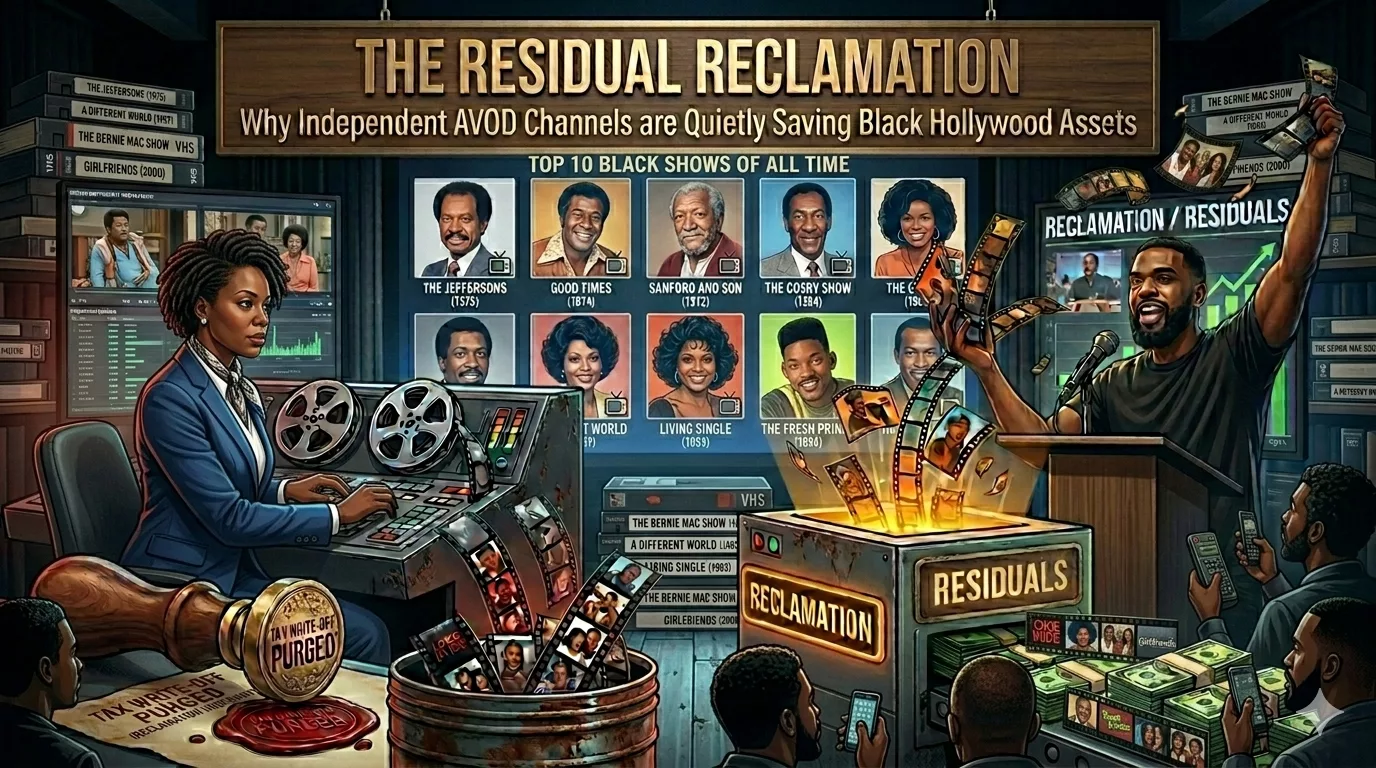
To understand how we arrived here, we must pull back the curtain on the cold, calculated mechanics of modern corporate accounting. When an SVOD giant purges a movie or television series from its platform, it is rarely a reflection of the content’s artistic value or its cultural resonance. It is an exercise in asset depreciation and tax optimization.
Under current corporate financial strategies, removing a title from a subscription platform allows a studio to declare that content as a financial loss. By writing down its book value, the company can instantly generate millions of dollars in tax write-offs to offset its quarterly earnings. To a tech executive answers to Wall Street, a classic Black indie film is worth more dead on a balance sheet than alive in a streaming queue.
This financial incentive is compounded by a systemic flaw in the streaming ecosystem: algorithmic redlining. SVOD business models rely entirely on subscriber acquisition and retention metrics. Their recommendation engines are optimized to push globalized, high-budget, broad-appeal content to the widest possible audience. Because these algorithms measure success through a narrow, homogenized lens, mid-budget Black titles are structurally deprioritized.
When a film is starved of algorithmic promotion, its viewership numbers naturally dip. The corporate parent then points to those manufactured low metrics to justify its removal, labeling the asset as “non-performing.” It is a self-fulfilling prophecy driven by data science that treats culturally specific art as mere dead weight.
The Underground Pipeline: The AVOD Rescue Mission
One platform’s tax write-off, however, is another platform’s goldmine. As major SVOD players abandon their archives, independent AVOD platforms and Black-owned distribution networks—such as Tubi, Pluto TV, Bounce, and smaller indie streaming networks—are quietly staging a massive intervention. They are entering the marketplace and licensing these discarded catalogs for a fraction of their original production costs.
This is not a charity case; it is a highly sophisticated, incredibly lucrative business model built on a fundamental misunderstanding of Black audience behavior by mainstream tech companies. Major SVOD platforms operate under the assumption that audiences must be constantly fed new, shiny, $200 million spectacles to remain engaged. AVOD distributors recognize a deeper truth: culturally specific audiences possess an immense appetite for high-intent, endlessly rewatchable comfort viewing.To a centralized streaming service, a 2002 Black romantic comedy or a 1997 urban drama is an obsolete artifact that fails to attract new international subscribers. But to an independent AVOD distributor, that same film is a highly monetizable asset.
AVOD platforms do not hide content behind a paywall; they make it free and easily accessible, monetizing it through targeted ad placements. Because these titles boast intensely loyal, dedicated fanbases who actively search for them, they generate consistent, high-volume ad impressions. The “free with ads” model—once dismissed by tech elitists as an outdated relic of the cable television era—has quietly become the most resilient preservation engine in digital media.
The Human Cost: The Math of the Residual Check
The broader significance of this reclamation extends far beyond consumer convenience or the preservation of film history. At its core, this is a battle for the financial survival of Black Hollywood’s working class.
In the traditional television and theatrical models, a creative’s long-term financial stability was secured through residuals—continuous payments made to actors, directors, and writers whenever a project was rerun, sold into syndication, or purchased on physical media. These checks historically formed the financial baseline that allowed working-class creatives to maintain their union health insurance, pay their mortgages between gigs, and sustain lifelong careers.
The rise of centralized SVOD platforms fundamentally broke this economic engine. Streaming residuals are notoriously opaque, often structured around flat-fee buyouts or complex formulas tied to a platform’s fluctuating global subscriber base rather than specific viewership. When an SVOD platform hosts a title but buries it deep within its algorithm, the creative receives pennies. When that platform purges the title completely for a tax write-off, the residual stream drops to an absolute zero.
AVOD economics shift this paradigm back in favor of the creator. Because AVOD monetization is directly tied to ad impressions, every single stream counts. Every time a viewer watches a classic film on a free platform and sits through a commercial break, real revenue is generated. A percentage of that ad revenue directly feeds back into the SAG-AFTRA and WGA residual pools.
For countless Black actors and behind-the-scenes creatives who formed the backbone of the 90s and 00s entertainment boom, these AVOD platforms have become an unexpected financial lifeline. The steady trickle of impression-driven residual checks ensures that their past labor continues to provide tangible, real-world equity, preventing their financial histories from being wiped clean by a corporate accountant’s pen.
The Manifesto: Owning the Literal Distribution Pipes
The quiet success of the AVOD reclamation exposes a profound truth that Black Hollywood, and independent creatives at large, can no longer afford to ignore: trusting centralized, corporate tech companies with cultural preservation is an existential danger.
For years, the entertainment industry operated under the illusion of inclusion, believing that securing a licensing deal or a production greenlight from a massive Silicon Valley-backed streaming platform represented the pinnacle of creative and financial success. But true creative independence cannot exist when you do not own the infrastructure. When an algorithm controls the archive, your culture is only permitted to exist as long as it remains convenient for a tech company’s quarterly stock performance.
The systemic purging of Black stories from major platforms is a modern form of digital sharecropping. Creatives are invited to build value on a platform’s land, only to have their labor devalued, obscured, or evicted the moment the corporate owner decides to pivot its strategy.
The ultimate lesson of the AVOD asset reclamation is that true cultural equity requires owning the literal distribution pipes. True sovereignty means building, supporting, and scaling independent distribution networks that view historical Black media assets not as liabilities to be written off, but as foundational cultural wealth to be preserved, celebrated, and continuously monetized.
By rescuing these films and television shows from the digital ether, independent AVOD distributors are doing more than just keeping the lights on for working creatives. They are proving that our cultural legacy possesses an enduring economic power that no corporate algorithm can accurately measure, and no corporate purge can truly erase. It is time to stop asking for a permanent home in someone else’s digital library and focus entirely on building our own.
About The Author