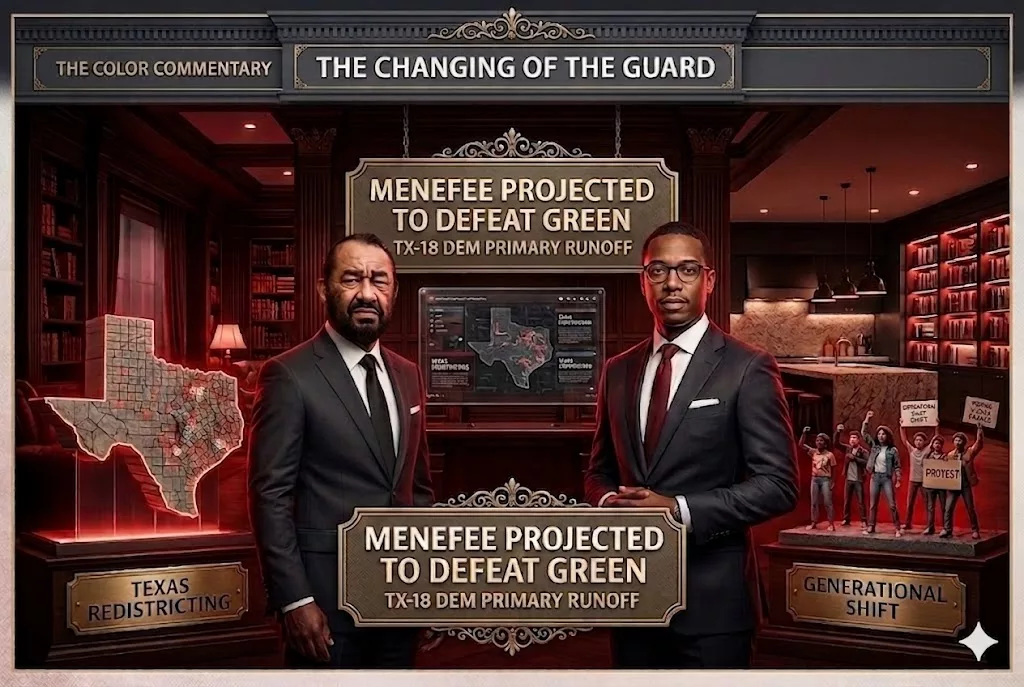
The official results of the high-stakes TX-18 primary runoff are finally in. Consequently, the political landscape of Houston will never be the same.
Freshman Representative Christian Menefee defeated eleven-term veteran Representative Al Green in a landslide victory, capturing roughly 68.6% of the vote to Green’s 31.4%. In this fierce, incumbent-on-incumbent battle—which a hostile, Republican-drawn map forced—the 38-year-old Menefee secured a decisive win over the 78-year-old Green. Therefore, this election brings a dramatic close to Green’s celebrated twenty-year career in Congress.
On its surface, the race looks like an electoral anomaly. Many observers view it as a geographic collision that partisan adversaries created through redrawn maps. However, a closer look reveals a much larger, more potent story about the modern Democratic coalition. The TX-18 primary runoff represents the intersection of aggressive mid-decade gerrymandering, multi-million-dollar super PAC warfare, and an unstoppable generational shift unfolding in one of the historic capitals of Black political power in the American South.
The Catalyst: A Map Handcrafted to Disrupt
To understand how two sitting progressive champions ended up on the same primary ballot, we must look at the extraordinary redistricting battle that shook Texas. At the behest of Donald Trump, the Republican-controlled Texas Legislature aggressively executed a mid-decade redistricting overhaul. Consequently, state Republicans engineered additional GOP-leaning seats, throwing Houston’s Democratic representation into chaos.
The political fallout in Houston was immediate and disruptive. Mapmakers essentially dismantled Al Green’s longtime 9th Congressional District and packed its deep-blue voters into the neighboring 18th District. Left with a fundamentally altered and highly unfavorable home turf, Green made the calculated decision to run in the newly configured 18th.
However, the 18th District was already occupied by a rising star who had just won his own trial by fire.
The 18th District survived an incredibly tumultuous two years. Following the passing of the legendary Representative Sheila Jackson Lee in July 2024, her daughter, Erica Lee Carter, briefly stepped in to finish her term. Former Houston Mayor Sylvester Turner then won the regular November election and took office in January 2025. Tragically, Turner passed away in office just two months later in March.
Subsequently, Christian Menefee entered the race. The former Harris County Attorney ran a relentless campaign to secure the seat, winning a highly competitive special election runoff in January 2026. Sworn into Congress in February, Menefee had barely set up his Washington office before he had to pivot immediately to defend his newly won seat. To learn more about how these legislative boundaries shifted, you can explore the historical profile of Texas’s 18th Congressional District on Ballotpedia.
The Crypto Elephant: Super PACs Find a Scalp
While local observers framed the primary as a clash of personalities and eras, outside money transformed the race into a national proxy war.
Al Green, a reliable voice of the traditional progressive establishment, had long been a vocal skeptic of emerging financial technologies. Consequently, he drew the ire of the cryptocurrency industry. Recognizing an opportunity in the redrawn district, the pro-crypto super PAC Fairshake poured millions of dollars into the Houston airwaves to actively unseat Green.
The strategy worked, and the industry was quick to claim credit. “Rep. Green’s defeat proves that anti-crypto hostility carries real electoral consequences,” noted Geoff Vetter, a spokesperson for Fairshake, on election night. You can track the campaign finance disclosures and independent expenditures for this race via the Federal Election Commission’s Campaign Finance Portal.
The super PAC’s heavy spending amplified Menefee’s digital-forward campaign while aggressively attacking Green. Ultimately, this proved that modern primary elections—even in deep-blue legacy districts—are increasingly subject to highly targeted, deep-pocketed special interest intervention. For Menefee, who had built a reputation fighting corporate polluters back in Houston, the influx of crypto cash created an ironic undercurrent to his campaign. Nevertheless, there is no denying the raw electoral math: the airwaves belonged to the future.
When Ideology Blurs, Age and Style Take Center Stage
Outside of the financial tech debate, there was little policy daylight between the two candidates. Both Menefee and Green are staunch, dependable progressive votes.
Green made his name nationally as an unapologetic civil rights crusader and a fearless antagonist of Donald Trump. In contrast, Menefee spent his tenure as the youngest and first Black Harris County Attorney using civil courts to defend local voting access against state encroachment. Furthermore, Menefee focused heavily on protecting marginalized communities from industrial pollution.
With matching progressive credentials, the race organically transformed into a referendum on energy, institutional style, and age.
| Candidate | Age | Political Brand | Primary Machine |
|---|---|---|---|
| Rep. Christian Menefee | 38 | Forward-looking institutional fighter, focused on structural civil rights, environmental justice, and systemic reform. First-generation college grad and former County Attorney. | High-energy, digital-first campaign apparatus running continuously since the late-2025 special election. |
| Rep. Al Green | 78 | Old-school civil rights champion, legendary fixture of Houston’s faith-based and community-leader networks. | Deep historic roots, relying on traditional block-walking, church pulpits, and high-propensity older voters. |
The successive losses of Sheila Jackson Lee and Sylvester Turner had already sensitized local voters to the realities of political mortality. For a younger generation of working-class families in Houston, the primary was a chance to step off the carousel of special elections and install a leader built for a multi-decade legislative fight.
While Green dominated in his historic stronghold of Fort Bend County, Menefee built an insurmountable wall of support in Harris County. He dominated early voting and captured a massive share of younger, newly engaged voters. For up-to-the-minute election numbers, check the live Texas primary runoff election results on Decision Desk HQ.
A New Template for Southern Progressivism
Menefee represents a distinct evolution in the Black political pipeline in the South. He is not a direct product of the mid-century civil rights leadership apparatus. Instead, he is a corporate litigator turned public-interest prosecutor who cut his teeth fighting structural, state-level voter suppression in the 2020s.
By demonstrating to a diverse, urban electorate that aggressive, tactical legal warfare could yield real protections against a hostile state government in Austin, Menefee proved his utility to modern voters. His campaign message leaned heavily into this forward-looking paradigm.
In a political environment where working-class families face compounding economic pressures and systematic gerrymandering, Menefee’s pitch was simple and effective: “I have the longevity, the legal acumen, and the modern toolkit to fight this fight for the next thirty years.”
What Lies Ahead
Because the redrawn 18th District remains a deep-blue fortress, Menefee’s victory on Tuesday virtually guarantees him a full term after November’s general election. In fact, Kamala Harris would have carried this newly configured seat by nearly 55 percentage points in 2024.
The loss of Al Green means the Texas Democratic delegation is losing more than two decades of institutional memory and a fearless, historical voice. But in return, Houston is sending a clear signal to the national party.
The future of the Democratic coalition in the South does not belong exclusively to the networks of the past. Rather, it belongs to a younger, structurally minded, tech-savvy generation of leaders who are comfortable operating at the intersection of local governance and national policy. Christian Menefee didn’t just win a primary; he codified a generational pivot that will shape Texas politics for the next generation.
About The Author