The dust has settled on the official announcement of the 78th Primetime Emmy Award nominations, and predictable headlines are already executing their well-worn, surface-level playbook. Mainstream trade publications are aggressively tallying the sheer volume of Black talent recognized across major categories as if we are still meant to be satisfied just sitting at the table. They are tracking Quinta Brunson’s continued comedy dominance with Abbott Elementary, celebrating Ayo Edebiri’s brilliant dramatic-comedy hybridity in The Bear, charting Yahya Abdul-Mateen II’s powerhouse turn in Marvel’s Wonder Man, and marveling at Zendaya securing her third career nomination for the final, polarized season of Euphoria.
On the surface, industry gatekeepers treat this as a victory for inclusion—a generous nod toward representation. But for a culturally conscious and professional audience, celebrating pure nomination volume feels archaic. If we limit our gaze to who is holding a gold trophy on September 14 at the Peacock Theater, we miss the actual empire being built.
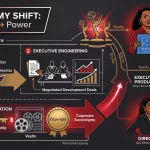
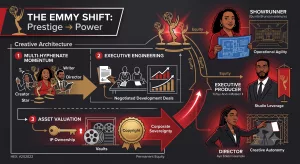
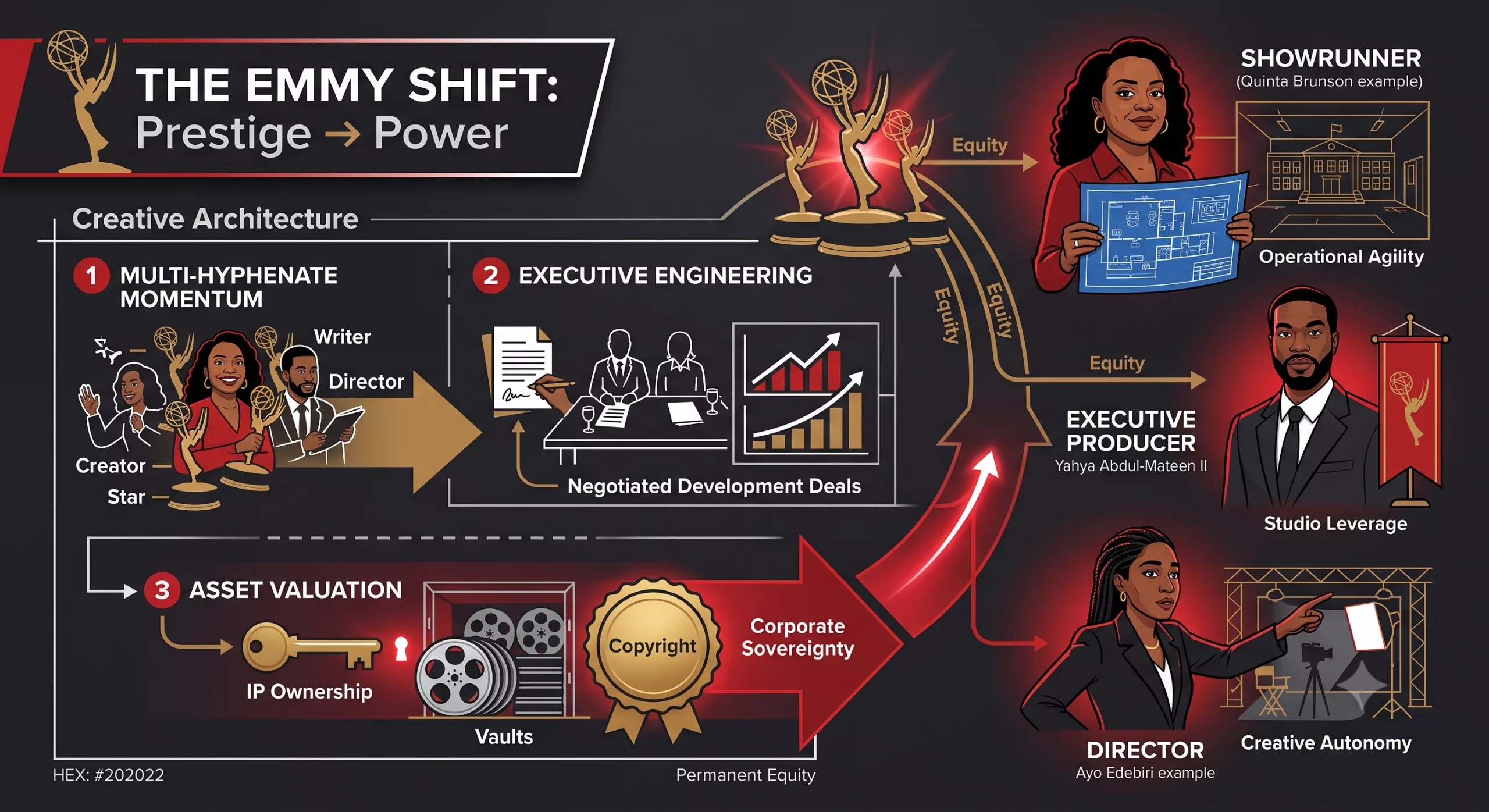
The real narrative of the 2026 Emmy shift isn’t about our people securing nominal validation from the Television Academy. It is about a profound, structural power shift occurring entirely behind the camera. We are witnessing a masterclass in executive engineering, where multi-hyphenate Black creators are systematically leveraging individual acting accolades into sweeping executive production deals, total writing room autonomy, and long-term ownership of their intellectual property. The modern Black corporate playbook in Hollywood has evolved past asking for permission: prestige is no longer the end goal; it is the raw currency used to buy back the master tapes of television.
From “Talent” to “Title”: The Multi-Hyphenate Blueprint
To understand how the creative architecture of television is being dismantled and rebuilt by Black visionaries, one must look closely at the transactional mechanics of the multi-hyphenate contract. Historically, Hollywood functioned on a neat segregation of labor designed to keep creators dependent: writers wrote, directors blocked, and actors performed. According to extensive labor data compiled by the Writers Guild of America, this structural division successfully kept creative leverage and generational wealth highly concentrated in the hands of legacy studio executives and network heads for decades.
Today’s vanguard has completely shattered those boundaries by weaponizing their onscreen gravity. Look at Quinta Brunson. When Abbott Elementary was nominated for Best Comedy Series again this year, it wasn’t just a win for ABC’s linear broadcasting model; it was a testament to Brunson’s operational model. As creator, executive producer, writer, and star, Brunson didn’t just sign a standard talent contract; she negotiated an expansive overall development deal with Warner Bros. Television. By expanding her structural agency in media, a concept we break down further on thecolorcommentary.com/business-of-entertainment, she controls the narrative ecosystem, commands the hiring of diverse personnel, and crucially, secures a massive back-end piece of the show’s syndication and streaming profitability.
Similarly, Ayo Edebiri’s trajectory offers an incredible case study in rapid corporate ascension. Winning an Emmy as an actor provided the exact leverage she needed to step into the director’s chair and secure an executive voice in how FX/Hulu structures its show’s chaotic, brilliant operational flow. This isn’t a favor granted by a generous studio; it is a calculated corporate retention strategy. Studios realize that in the fragmented streaming era, our talent is the brand infrastructure.
The Architecture of the Deal: Buying Back the IP
In traditional Hollywood accounting, intellectual property (IP) is a fortress fiercely guarded by legacy studios. An actor could work for a decade on a hit series and leave with nothing but a SAG pension and a collection of wardrobe items. The 2026 Emmy nominees represent an unapologetic class of creators who refuse to be line items on someone else’s balance sheet.
Take Zendaya’s structural positioning within the Euphoria universe. While the final season faced steep creative headwinds and polarized critical receptions, Zendaya’s leverage remained entirely untouched. Her nomination for Lead Actress in a Drama Series highlights an undeniable truth: she holds complete structural equity over the property. Beyond her acting salary—which famously reset the industry standard for Gen Z performers—her executive producer credit on the series gave her an unprecedented veto and directional voice over the show’s ultimate rollout. Her career moves read like an intentional corporate blueprint, utilizing hyper-visible acting prestige to fund and anchor independent production ventures that own their concepts from day one. Tracking these types of asset management strategies on thecolorcommentary.com/creative-capital shows how parallel wealth-building models are executed across other high-stakes spaces.
The playbook is clear:
- Acquire critical mass: Use highly visible acting performances to capture the cultural zeitgeist.
- Exert leverage at renegotiation: Swap immediate cash bumps for equity, executive producer titles, and overhead company funding.
- Establish an independent banner: Funnel studio capital into a personal production company (e.g., Brunson’s Fifth Chance, Zendaya’s various joint ventures) to incubate original IP that the creator controls.
By executing this strategy, these creators shift from being employees to joint-venture partners with entities like Apple TV+, HBO Max, and Netflix. They are transforming fleeting industry momentum into permanent institutional leverage.
Navigating the Streaming Consolidation Era
The timing of this structural coup is incredibly significant. The television landscape of 2026 is radically different from the peak-TV boom of the late 2010s. We are living through an era of severe studio consolidation, tightening production budgets, and a hyper-commoditized streaming market. According to recent reports detailing The Hollywood Reporter industry data, overall scripted series volume has plateaued as platforms prioritize immediate profitability over sheer content mass.
In a restricted market, studios become incredibly risk-averse. They lean heavily on proven commodities and institutional voices. This is where the creative architecture of multi-hyphenates becomes an indispensable asset for networks. When a platform partners with someone like Yahya Abdul-Mateen II—who pulled double duty anchoring Marvel’s Wonder Man while driving high-end creative development through his own production banner, House Eleven10—they aren’t just hiring an actor. They are outsourcing the creative incubation process to an elite, culturally attuned boutique firm.
Abdul-Mateen II’s Emmy recognition is particularly telling given how poorly Wonder Man was marketed by the studio. Despite a quiet, almost subterranean promotional rollout that left Black and culturally locked-in fans to discover the show’s brilliant Hollywood satire purely through word-of-mouth, Abdul-Mateen II’s undeniable performance forced its way into the Academy’s good graces. His strategy mirrors the corporate playbooks of classic Hollywood moguls, updated for a fractured digital ecosystem. By embedding his production company directly into the infrastructure of major studio slates, he ensures that his firm retains development fees, overhead coverage, and a seat at the table when global distribution rights are negotiated. This shift in how media deals are structured perfectly mirrors macro-trends covered on thecolorcommentary.com/culture-and-currency, where cultural equity is converted into tangible corporate sovereignty.
The Writing Room as a Boardroom
We must also look at how this executive evolution is fundamentally re-engineering the mechanics of the writers’ room. Historically, the showrunner held absolute, autocratic power, frequently isolating the cast from the conceptual architecture of the series—a dynamic that traditionally excluded Black voices from the final edit. When the creator, showrunner, and star are fused into a single corporate entity—or when actors wield the executive leverage to dictate writing room autonomy—the traditional power dynamics collapse. For those studying corporate governance, the Harvard Business Review frequently highlights how horizontal leadership models outpace rigid, vertical hierarchies in fast-moving markets.
This structural evolution yields two distinct corporate advantages:
- Operational Agility: Decisions regarding narrative direction, casting, and resource allocation don’t need to pass through tortuous networks of studio bureaucracy. The board room and the table read become one and the same.
- Talent Incubation and Retention: Black multi-hyphenate leaders systematically use their corporate leverage to pull up the next generation of diverse writers, directors, and line producers. They are building a self-sustaining corporate ecosystem that completely circumvents traditional Hollywood gatekeeping.
When Abbott Elementary or The Bear populates the creative categories at the Emmys, it represents an institutional shift. It means the individuals setting the budgets, approving the scripts, and greenlighting the spin-offs look radically different from the legacy executive suites of Hollywood’s past century. Examining the organizational psychology and leadership frameworks that make these rooms successful on thecolorcommentary.com/leadership-frameworks reveals exactly how these diverse ecosystems sustain their creative momentum.
Redefining the Value of Hollywood Prestige
Ultimately, the 2026 Emmy nominations demonstrate that the currency of Hollywood prestige has been thoroughly redefined. A generation ago, an Emmy win was a vanity metric—a beautiful trophy to place on a mantlepiece while waiting for the phone to ring for your next audition.
For the modern class of Black cultural executives, an Emmy nomination is an asset valuation report. It is concrete evidence brought to the negotiating table to demonstrate brand equity, undeniable audience loyalty, and creative infallibility. As outlined by entertainment legal analysis at Variety, it is the precise leverage required to demand true backend participation, international distribution percentages, and the holy grail of media economics: absolute ownership of the copyright.
As we watch the star-studded arrivals at the Peacock Theater this September, the true metrics of success won’t be found in the televised acceptance speeches. The real victories have already been won in the redlined pages of production contracts, the corporate structuring of independent production banners, and the master service agreements signed years before the cameras even rolled.
The narrative of representation is officially dead, replaced by an era of absolute ownership. The creative architecture has shifted, and Hollywood is finally realizing that the talent isn’t just appearing in the show—we own the studio.
About The Author